
Free Shipping
Door to Door All Across America
Door to Door All Across America


Step into a contemporary high-end kitchen, range hood is always a focal point—the architectural centerpiece that defines the space. Yet just a few decades ago, the situation was vastly different.
The range hood has undergone one of the most significant transformations in residential design: evolving from a noisy, purely utilitarian appliance hidden behind cabinetry into a bespoke luxury centerpiece that seamlessly blends high-performance ventilation system, refined materials, and architectural aesthetics.
We explore this evolution—shifting from "function-first" engineering to "design-driven" craftsmanship—and analyzes how modern homeowners value custom metalwork, sculptural forms, and weathered finishes with a sense of history just as much as they value performance.
Early range hoods had only one function: exhaust.
Early kitchen ventilation systems were designed purely for functionality, without regard for aesthetics or integration with interior design.Typical features included:

v Boxy, industrial shapes
v Thin stainless steel or plastic housing
v Loud, single-speed motors
v Minimal filtration efficiency
During this period, range hoods were viewed as elements that disrupted visual continuity. Common design strategies involved concealing them within cabinetry or blending them seamlessly with surrounding finishes.
Their performance was also relatively limited—characterized by low airflow (CFM), high noise levels, and basic grease filtration—meaning they were suitable only for light-duty cooking.
As open-concept kitchens became more popular, range hoods could no longer be hidden. They became visible elements within the kitchen layout—and design expectations have shifted accordingly.
Two major changes have occurred during this period:

Range hoods moved beyond simple boxes into more intentional forms:
v Chimney-style wall mounted range hood designs
v Early island range hood installations for open kitchens
For the first time, the hood was considered part of the kitchen composition.
Manufacturers have introduced:
v Variable-speed motors
v Models with higher airflow (CFM)
v Higher-efficiency grease filtration systems
However, exterior finishes remain relatively basic—primarily stainless steel or standard black—and customization options are still limited.
In today's high-end kitchens, the range hood has evolved into a true design highlight.
No longer concealed or downplayed, it is deliberately showcased, serving as the visual focal point of the kitchen.
This transformation stems from three key innovations:

Mass-produced finishes have given way to artisan-crafted metals such as copper and brass.
Unlike static factory coatings, these materials develop a natural patina over time, gradually shifting from a bright polished surface to a rich, warm, aged tone. Each piece becomes unique to the home it belongs to.
Modern luxury range hoods often feature brushed finishes that eliminate visible grain patterns.
This creates:
v A softer, more uniform visual texture
v Better light diffusion across curved surfaces
v Improved resistance to visible scratches and wear
The result is a cleaner, more elegant appearance suited to high-end kitchens.
Today's range hoods are no longer standardized products.
They are custom-built architectural elements featuring:
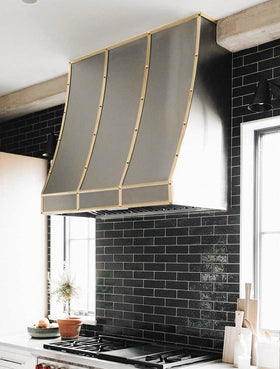
v Curved and symmetrical silhouettes
v Handcrafted detailing such as rivets or molding
v Fully tailored dimensions for each kitchen layout
Whether as a wall mounted range hood or a suspended island range hood, each design is made to integrate seamlessly into the overall interior vision.
A common misconception is that luxury range hoods prioritize aesthetics over performance. In reality, modern designs have achieved significant improvements in both areas.
Optimized airflow for both wall and island configurations
In other words, design and engineering now work collaboratively rather than competing with each other.
The next evolution of range hood design focuses on individuality and longevity.
Instead of maintaining a "perfect" factory finish, homeowners increasingly value materials that age naturally. Copper and brass surfaces evolve over time, developing depth, character, and a sense of history within the home.
At the same time, full customization—from size and shape to finish and detailing—ensures that no two range hoods are exactly the same.
The evolution of the range hood mirrors the transformation of the modern kitchen style.
It has evolved from a concealed mechanical fixture into an iconic architectural design element—perfectly blending advanced ventilation performance with handcrafted materials, sculptural forms, and timeless aesthetics.Today, a luxury custom range hood is no longer just an appliance. It is a lasting centerpiece that brings together function, craftsmanship, and design identity in the heart of the home.
Leave a comment